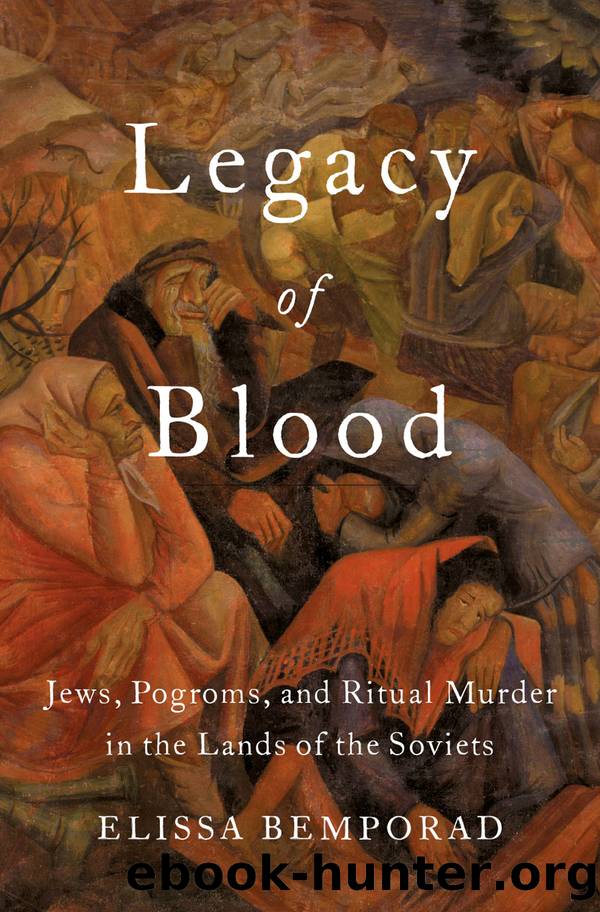
Legacy of Blood by Elissa Bemporad
Author:Elissa Bemporad [Bemporad, Elissa]
Language: eng
Format: epub
Published: 2019-12-15T00:00:00+00:00
The Return of the Unthinkable
In the fall of 1945, a pogrom caused havoc in the streets of Kiev.75 On the afternoon of September 4, Lieutenant Josef Rozenstein, a Jewish NKGB senior radio operator, was on his way back home from the bread store when he was attacked by two servicemen. First they confronted him with the antisemitic slur of âTashkent partisan,â implying that like most Jews, instead of fighting at the front, he had âenjoyedâ evacuation; then they physically attacked him. In retaliation, the lieutenant took the law into his own hands and sought revenge. Wearing his NKGB uniform for a semblance of legality, he shot and killed both men. This action sparked instant unrest in the city: a large crowd gathered around the dead bodies and attacked the lieutenantâs wife and a Jewish man passing by. Both were severely injured. The next day, the servicemenâs funeral further ignited ethnic tensions, as the procession quickly turned into a pogrom. It began with antisemitic slogans, chanted through the cityâs main streets, and eventually deteriorated into violence against Jews, in particular in the area around the marketplace. Thirty-six of the one hundred victims in the attacks were hospitalized; five were murdered. The violence also affected a number of non-Jewish civilians âwho looked like Jews.â Apparently the local police did not intervene until a few days later. But Lieutenant Rozenstein was no Scholem Schwarzbard, and on October 1, 1945, the military tribunal sentenced him to death.76
Shocked by the Kiev pogrom, four Jewish Communist Party members and war veterans who had fought at the front wrote a passionate letter addressed to Stalin, to the NKVD chairman Lavrentii Beria, and to Pravdaâs chief editor, P. Pospelov. They openly complained about the abnormal political atmosphere in their city, where antisemitism reigned. They protested that âââ[B]eat the Yids,â the favorite slogan of German fascists, Ukrainian nationalists, and the tsarist Black Hundreds is heard through the streets of the capital of Ukraine, in the trams, trolley-buses, stores, the marketplace, and even in some Soviet institutions.â77 The war veterans voiced their dismay, hinting at the collapse of the founding myth of Soviet Jewry, namely the absence of pogroms: â[I]t is a disgrace for our Party and our socialist motherland that a Jewish pogrom occurred here in Kiev under the Soviets . . . after our victory over German fascism. [I]t will be written in the history of our Revolution that the first Jewish pogrom since the collapse of tsarism occurred . . . on the 28th year since the October Revolution.â78
The long letter was above all an open attack on local authorities. The petitioners identified them as chiefly responsible for the context that led to the violence, which could result, they feared, in a pogrom of even greater magnitude, âone worthy of Hitler and Goebbels.â79 According to the veterans, Rozensteinâs decision to kill the two servicemen who attacked him grew out of the local authoritiesâ indifference to the plight of the Jews.80 They were âenemies of the people,â argued
Download
This site does not store any files on its server. We only index and link to content provided by other sites. Please contact the content providers to delete copyright contents if any and email us, we'll remove relevant links or contents immediately.
| Africa | Americas |
| Arctic & Antarctica | Asia |
| Australia & Oceania | Europe |
| Middle East | Russia |
| United States | World |
| Ancient Civilizations | Military |
| Historical Study & Educational Resources |
The Dawn of Everything by David Graeber & David Wengrow(1707)
The Bomber Mafia by Malcolm Gladwell(1622)
Facing the Mountain by Daniel James Brown(1553)
Submerged Prehistory by Benjamin Jonathan; & Clive Bonsall & Catriona Pickard & Anders Fischer(1455)
Wandering in Strange Lands by Morgan Jerkins(1430)
Tip Top by Bill James(1416)
Driving While Brown: Sheriff Joe Arpaio Versus the Latino Resistance by Terry Greene Sterling & Jude Joffe-Block(1376)
Red Roulette : An Insider's Story of Wealth, Power, Corruption, and Vengeance in Today's China (9781982156176) by Shum Desmond(1359)
Evil Geniuses: The Unmaking of America: A Recent History by Kurt Andersen(1353)
The Way of Fire and Ice: The Living Tradition of Norse Paganism by Ryan Smith(1336)
American Kompromat by Craig Unger(1315)
F*cking History by The Captain(1304)
It Was All a Lie by Stuart Stevens;(1300)
American Dreams by Unknown(1286)
Treasure Islands: Tax Havens and the Men who Stole the World by Nicholas Shaxson(1273)
Evil Geniuses by Kurt Andersen(1257)
White House Inc. by Dan Alexander(1212)
The First Conspiracy by Brad Meltzer & Josh Mensch(1174)
The Fifteen Biggest Lies about the Economy: And Everything Else the Right Doesn't Want You to Know about Taxes, Jobs, and Corporate America by Joshua Holland(1126)
